A human-centric approach to cross-agency service coordination in Alberta
The Problem
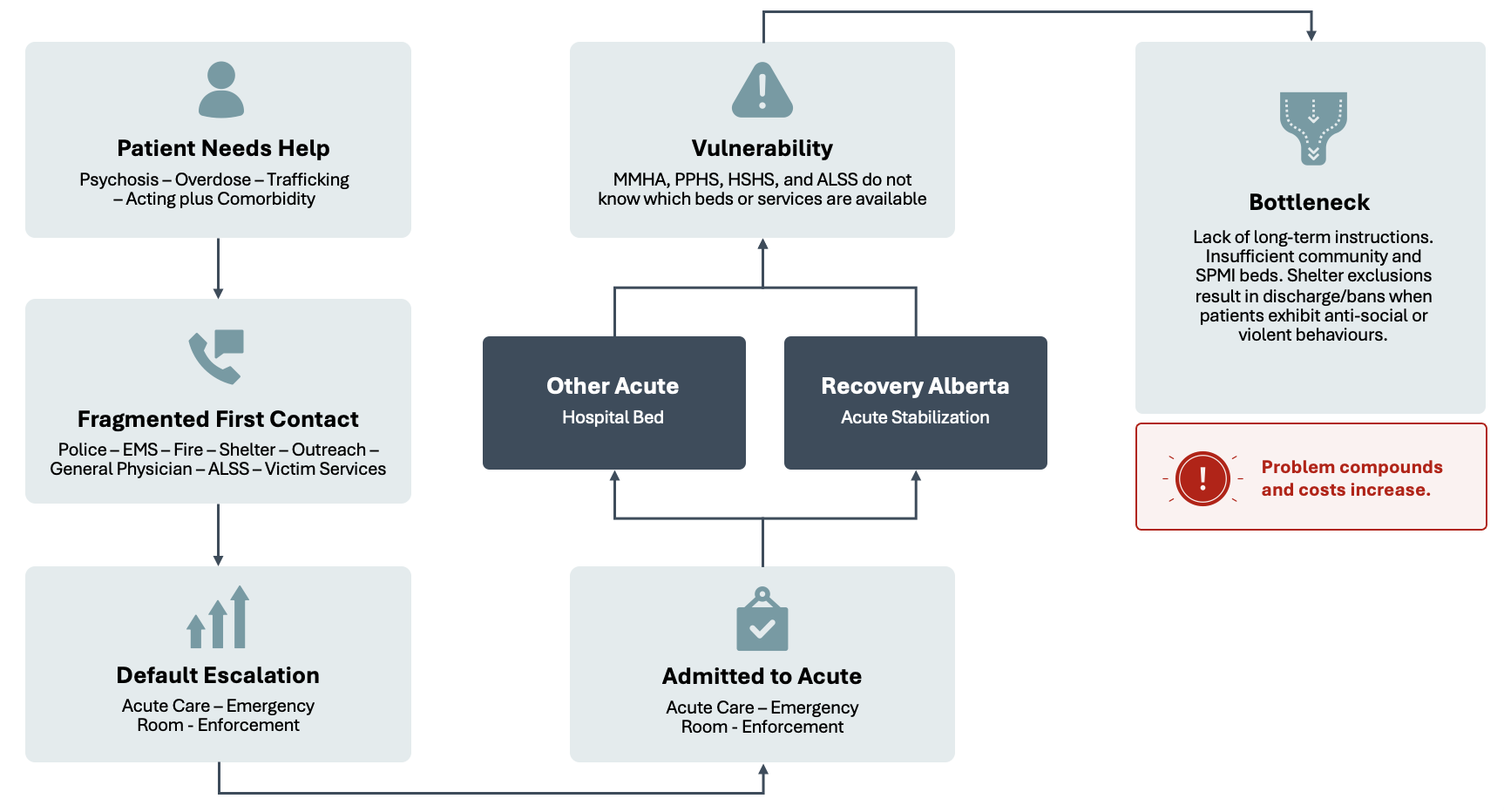
No one is accountable for the whole person
People with complex, concurrent needs — spanning severe and persistent mental illness, addiction, housing, health, justice, and social supports — must navigate a set of services that were funded, structured, and governed to operate separately. Because no single part of the system is accountable for the whole person, access depends on individual resilience, personal relationships, and luck rather than on coordinated design. The result is fragmented, crisis-driven care that is costly to the system and re-traumatizing to the people it is meant to serve.
The History
Fifty years of accrued fragmentation
The fragmentation was not designed; it accrued over fifty years as the system was emptied of one model of care at a time without ever funding its replacement.
1970s — deinstitutionalization begins
The large psychiatric institutions start to empty, on the promise that care will move into the community. Whatever its harms, the institution had performed one quiet function: it held the whole person in one place.
Further reading — Alberta deinstitutionalization in the record
Most 1960s–80s newspaper coverage sits in microfilm and paywalled archives. These are the openly available retrospectives, histories, and later-wave closure stories that document the era.
1980s — closures continue with no replacement plan
The promise goes unfunded. The beds close; the community system that was supposed to catch people is never actually built.
Further reading — Alberta's acute-care bed closures in the record
Open-web coverage thins out for the 1980s; most digitized material documents the 1990s Klein-era funding cuts, the 1994 regionalization, and the hospital closures that eliminated acute-care beds. These are the contemporaneous reports and academic studies that track that arc.
A powerful new driver of need arrives and lands on a system already missing its middle; addiction and mental health, never reintegrated after deinstitutionalization, compound one another.
Further reading — Alberta and the roots of the opioid crisis in the record
Alberta's mass-mortality opioid wave is a 2010s, fentanyl-driven event — but its roots run to the 1990s. Contemporaneous Alberta-specific coverage is scarce on the open web, so much of the strongest material is national: the 1996 OxyContin approval and the prescribing it drove, alongside Alberta's monitoring program and the prairie ‘Ts and Rs’ precursor.
2000s — homelessness, addiction, and comorbidity rise (including among senior citizens)
Need stops arriving in single, mandate-shaped categories and starts stacking — the same person now carries several conditions at once.
Further reading — homelessness, addiction, and the comorbidity load in the record
From the 2000s, three Alberta threads rise together — homelessness, addiction, and senior poverty — and increasingly converge in the same person. Homelessness and addiction are well documented with Alberta-specific sources; senior-poverty coverage is thinner and leans national. The richest evidence sits at the intersection: aging, housing loss, mental illness, and substance use.
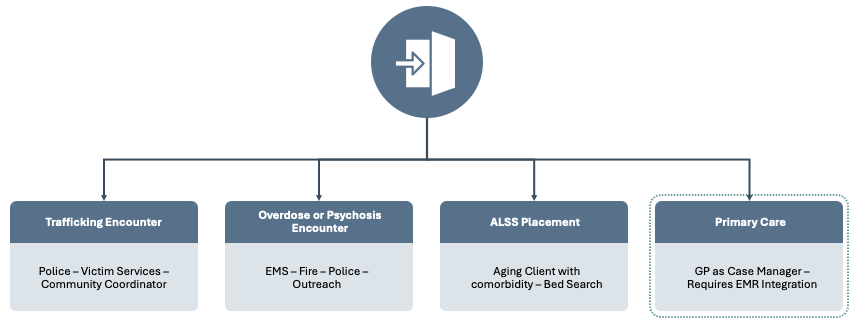
It shows up in homelessness, crisis response, acute care, and justice. The person whose needs cut across every line is now the typical presentation, not the exception.
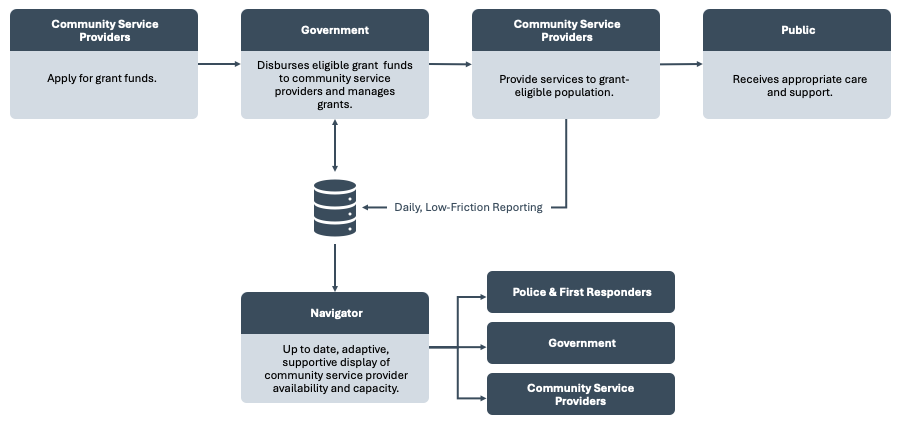
Loading the Navigator practitioner interface. This is the tool a case worker, frontline officer, or system coordinator uses to find available services, make referrals, and confirm whether connections were made.
Platform
No Wrong Door
The Integrated Services Navigator is a deployed alpha prototype of a role-based service-navigation web app which began with Alberta's anti–human-trafficking / community-safety response and is expanding to include additional information and community service providers to support the whole person.
The Navigator connects people to available services across organizational boundaries, in real time, and tracks whether the connection was made.
How it Works
Practitioner tool examples are shown below: the current information that a case worker, a frontline officer, or a system coordinator uses when they need to find what is available, make a referral, and know what happened next. The Navigator shows which services have capacity right now, initiates consent-gated referrals, and confirms whether the person actually connected.
Triaged real-time connectionsLive, natural-language voiceService coverage at a glanceCurrent capacity and details
Funder Workflows
Reading the system from a funder's altitude
Three system-level workflows — the funder-altitude counterpart to the police diversion scenarios — ride the Government / Planning role to answer a provincial grant funder's three questions about their region: what is available, what is not, and what is most needed. Figures shown in the prototype are seeded demo data; each card's deployed reference says so plainly.
F01 · funder lens
Show me the whole province at once
Government / Planning · regional supply, at a glance
Q1 What is available in my region right now?
Scenario details
Who runs it
Dana Whitecalf — Regional Grants Officer, North Zone
Region in focus
Fort McMurray · Grande Prairie · remote northern communities
Question answered
Q1 · What is available in my region right now?
What it reads
Provider count and top service types per region, plus the Alberta-Coverage-by-Region density heatmap
Prototype routes
/select-role/coverage/admin/coverage
The funder's question · system view
A North Zone grants officer opens the Government / Planning view and, for the first time, sees the whole province at once instead of one provider at a time. The Coverage screen rolls every region up to a provider count and its top service types, and the Alberta-Coverage-by-Region heatmap lights Calgary (94) and Edmonton (82) bright while the North (18) and Remote Communities (9) sit dim and small. She isn't hunting for one shelter; she's reading the shape of the portfolio. The density contrast does the arguing for her — two metro zones hold roughly five times the supply of the entire north — and becomes the agreed baseline she carries into her allocation committee before anyone debates where the next dollar goes.
The Coverage workflow
Open the Government / Planning roleThe one system-altitude door — “coverage data and system-level views” — distinct from the Law Enforcement and Crisis roles the diversion scenarios above ride on.
Read the per-region rollupEach Alberta region renders as a card: how many providers operate there and its ranked top service types, assembled side by side for comparison.
Open the Alberta Coverage by Region heatmapZone tiles scaled and coloured by provider density — Calgary 94 and Edmonton 82 burn bright; North 18 and Remote Communities 9 sit dim — with a Low / Med / High legend.
Carry the baseline into the allocation briefThe download affordance takes the province-wide rollup into committee as the picture everyone agrees on before the fund / sustain / reallocate debate.
What the funder sees
Provider count per regionTop service types per regionProvince-wide density heatmapSide-by-side regional compare
Elevate's relevant Canadian work
AB MHA Strategic Direction & Design (2025)Health System Transformation · Rewire (HLTH, 2025)EMCR Search and Rescue Gap & Needs Analysis (2024–25)Quality Reporting Platform (outcomes data)
Deployed reference
On the deployed Community Safety Framework prototype, the Government / Planning role opens /coverage — a per-region rollup of provider counts and top service types — and /admin/coverage, the “Alberta Coverage by Region” density heatmap. In the prototype the figures are seeded demo data and the “My Region” toggle is pinned to Edmonton; a production build reads region from the service_capacities table across the seven-region Alberta taxonomy and lets each funder scope to their own zone.
Marcus Trembley — Provincial Funding Director, Community Safety portfolio
Region in focus
All seven Alberta regions · Edmonton-based
Question answered
Q2 · What is NOT available in my region right now?
What it reads
Each region scored against the shelter and legal-aid pillars; criticals ranked fewest-providers-first
Prototype routes
/coverage/search/admin/coverage
The funder's question · system view
A provincial funding director needs triage, not a directory. The Coverage screen scores every region against two pillars an anti-trafficking response can't function without — does it have a shelter, does it have legal aid — and floats the worst to the top of a CRITICAL GAPS list, labelled in his own words: ‘no Shelter · Legal’, ‘no Legal aid’, ‘no Trafficking shelter’. Critical regions wear a red badge and a line like ‘Only 3 providers — nearest dedicated services may be hundreds of km away.’ One tap deep-links him into that region's inventory to see what little is actually there. It is the readiest priority queue in the tool — provided he reads the demand badge as inferred scarcity, not measured need.
The Coverage workflow
Open the CRITICAL GAPS panelBeneath the regional rollup, each region is scored against the shelter and legal-aid pillars and stamped Good coverage, Coverage gap, or Critical gap.
Work the queue worst-firstThe criticals aggregate into one panel sorted by fewest providers, so the most starved region floats to the top, named by the service type it is missing.
Deep-link into the flagged regionOne tap from a gap jumps to /search scoped to that region to inspect the actual (thin) inventory before committing a dollar.
Capture the priority listThe same gap family renders in the admin shell beside the heatmap, ready to export into the allocation brief.
What the funder sees
Shelter + legal-aid pillar checkCritical / gap / partial severityWorst-first priority queueOne tap into regional inventory
Elevate's relevant Canadian work
Alberta Centre — Trafficked Persons program integrationAB MHA Strategic Direction & Design (2025)EMCR Search and Rescue Gap & Needs Analysis (2024–25)AB CMHA Lived Experience Governance Model
Deployed reference
On the deployed prototype, /coverage classifies each region against shelter and legal-aid availability and aggregates the criticals into a CRITICAL GAPS queue sorted by fewest providers, with one-tap deep-links to the region's search. In the prototype the thresholds and a “HIGH DEMAND · 0 PROVIDERS” tag are heuristic and supply-derived — a scarcity proxy, not measured demand. A production build carries real per-organization signal through the providers.identified_gaps field and adds a measured-demand input (referral volume, waitlists) so “most needed” is counted, not inferred.
Government / Planning · gaps by service type & stage
Q2 What is NOT available — across the stages of the survivor journey?
Scenario details
Who runs it
Priya Anand — Provincial Program Analyst, survivor pathways
Region in focus
Province-wide · across the recovery journey
Question answered
Q2 · What is NOT available across the stages of the survivor journey?
What it reads
Providers ranked by service type, colour-coded by recovery stage (Survival / Stabilization / Integration)
Prototype routes
/admin/coverage/coverage
The funder's question · system view
A program analyst asks a question the regional gap list can't answer: even where providers exist, is the province over-built at the crisis door and starving the recovery end? The ‘Providers by Service Type’ bar, colour-coded by recovery stage, makes it plain — Emergency Shelter towers at 52 (Survival), the stabilization band sits in the middle, and Immigration Services — essentially the whole Integration stage — bottoms out at 14. She reads it as a journey-stage gap: Alberta has stacked capacity at the front door and thinned out exactly where survivors rebuild toward independence. She flags integration-stage capacity as the cycle's strategic underweight and steers growth grants there instead of adding another shelter line — a province-wide ‘where to look’, not yet a costed case.
The Coverage workflow
Open the Coverage Gap DashboardThe admin-shell view that holds the service-type breakdown alongside the regional heatmap.
Read the Providers by Service Type barEach service type is a count bar, colour-grouped by recovery stage: Survival, Stabilization, Integration.
Spot the journey-stage gapEmergency Shelter 52 (Survival) towers; Immigration Services 14 (Integration) bottoms out — a heavy front door and a thin recovery end.
Pair stage with regionCombine ‘which stage is thin’ (this bar) with ‘which region is thin’ (the CRITICAL GAPS list) to target the growth grant precisely.
What the funder sees
Service type ranked by supplyRecovery-stage colour codingSurvival / Stabilization / IntegrationProvince-wide stage imbalance
Elevate's relevant Canadian work
Health System Transformation · Rewire (HLTH, 2025)AB MHA Strategic Direction & Design (2025)FCSD Functional Assessment (HLTH, 2024)Quality Reporting Platform (outcomes data)
Deployed reference
On the deployed prototype, /admin/coverage renders “Providers by Service Type” as stage-coloured count bars (Survival / Stabilization / Integration). In the prototype the service-type labels are demo-authored and the three-tier legend simplifies the canonical four-stage survivor_support_stage taxonomy (Crisis Intervention, Risk Mitigation & Engagement, Comprehensive Recovery, Independence Building); the bar is province-wide with no region cross-tab. A production build maps the service taxonomy to that four-stage enum and adds a region dimension so the analyst can read stage gaps region by region.
The rest of this site is the problem and the machinery underneath it. This section is the other end — what a Tuesday night looks like once the machinery works. Start here, then work backwards.
11:40pm, Red Deer. A welfare check at an address the officer has been to before — same man, fourth time this year. Manic, off his medication, not violent, carrying nothing. The officer has talked him down before and can do it again. What he has never had is a third option.
Tonight he has one. The prompt arrives in his glasses: see-through, open-ear, no screen to look down at, no attention taken off the person standing in front of him. It does not tell him what to do. It tells him what is actually available at 11:40 on a Tuesday — that this man already has a peer-support worker at CMHA Central Alberta, that the worker is reachable now, that Recovery Alberta has a same-day triage slot in the morning, and that consent to make the connection is already on file.
He makes one call instead of a two-hour round trip. The man goes to someone who already knows him, rather than to a cell or to an emergency room that has nothing to offer mania. The officer is back in service in twenty minutes.
And here is the part that matters to everyone upstream: the handoff is confirmed. Not “referred” — confirmed. The officer knows the connection landed before he clears the call, and so does the system.
None of this is waiting on new hardware. See-through glasses with on-board AI, contextual listening and open-ear prompts are shipping today at roughly $500 a unit. The device is not the constraint. The constraint is that nothing behind the device knows which services are open tonight, who is already working with this person, or whether the handoff ever landed. That is a data and interoperability problem — and it is the one this work solves.
Outcomes
What changes, by role
Police · at the point of encounter
The call ends in a handoff, not a cell. The officer gets a third option and the shift time back — no transport, no emergency-room wait, no report written against a charge nobody wanted. He clears the call knowing the person landed somewhere, because the system confirms it rather than assuming it.
Government · the funder’s altitude
Referral counts stop being the measure. Because every handoff is confirmed rather than assumed, a funder can see which doors are actually open in which region tonight, where the recovery journey thins out, and where the next dollar buys the most. The same record that closes the loop for the officer is the record that makes the system legible from above — one capture, both uses.
Community service providers · the receiving end
The referral arrives with context and consent already attached, instead of a name and a phone number. The provider knows who is coming, what has already been tried, and what they are permitted to see — and confirming the person arrived is a single tap rather than a monthly reporting exercise.
Each of these is worked end to end in the sections that follow. The officer above is P179, the first of the four police scenarios — the same man, the same night, with the pathway traced step by step.
Frontline
ER Diversions and Warm Handoffs
Four police-diversion scenarios drawn from crisis events with officer involvement where the Integrated Pathways Navigator triages the person to a community service provider instead of an emergency room or acute care. Each pathway walks the same Integrated Pathways Explorer routes in the same order; the portraits are representational and depict no real person.
01 · P179
I don't want to arrest him
Bipolar I plus stimulant use disorder, episodic homelessness, frequent ER
Case details
Age · Gender
38 · M
Location
Red Deer, AB
Indigenous identity
None
Language
English
Housing baseline
Stable (episodic homelessness)
Income
$15K–$25K
Consent status
Refusing services
Diagnoses
F31.13 Bipolar I, current/recent manic, severe
F12.20 Cannabis Use Disorder
Trauma
Variable
Scores
family 8isolation 8SDOH cx 10crisis cx 6engagement 3
Priors
3 inpatient0 ER (12 mo)3 homeless episodes
The problem · from the corpus
Thirty-eight, Red Deer, bipolar I in an acute manic episode with a cannabis comorbidity. Three prior inpatient stays, three homelessness episodes, an SDOH-complexity score of 10/10, baseline consent ‘refusing services.’ An officer takes a welfare-check call: pressured speech, agitation, off his medication, no weapons, no warrant. The default ending is an arrest no one wants or an ER bed that does nothing for mania. He de-escalates; the man settles enough to talk. The question the framework answers is whether the officer has a community door to hand him through — peer outreach, same-day mental-health triage — instead of the only two doors policing usually owns.
The Integrated Pathways Explorer pathway
Law Enforcement on a welfare checkRed Deer officer opens the Triage tool in the Law Enforcement role rather than defaulting to arrest or apprehension-under-the-Mental-Health-Act.
Manic · de-escalated · not violentTags: acute mania · medication non-adherence · de-escalated · no weapons. Triage names a “strong diversion window” — community, not ER.
Central Zone community MHSurfaces the AHS Mental Health Help Line (mobile-crisis dispatch), Recovery Alberta Central Zone intake, and CMHA Central Alberta peer outreach.
CMHA Central Alberta cardPeer-support / community-outreach worker who can meet him where he is and bridge him back to medication re-engagement.
Warm handoff — no arrest, no EROfficer connects him to the clinician line and CMHA outreach; a same-day Recovery Alberta triage slot is set. The file records a diversion, not a charge.
Elevate solution stack
AI Mental-Health NavigationCross-sectoral Pathway ViewShared Public Treatment PlatformSecure MessagingShared Medication Record
Elevate's relevant Canadian work
AB MHA Strategic Direction & Design (2025)AB CMHA Lived Experience Governance ModelHealth System Transformation · Rewire (HLTH, 2025)GOV Health Emergency Management (HEM, 2024)Canadian Centre of Recovery Excellence — Agency Stand-Up
Deployed reference
Run against the deployed Triage tool in the Law Enforcement role, this scenario returns a community-diversion plan — the AHS Mental Health Help Line (1-877-303-2642) with mobile-crisis dispatch, Recovery Alberta Central Zone intake, and CMHA Central Alberta peer outreach — and explicitly names it a “strong diversion window” for a calm, consenting presentation. The clinical decision stays with a clinician, not the officer.
Bipolar I plus stimulant use disorder, episodic homelessness, frequent ER
Case details
Age · Gender
37 · M
Location
St. Albert, AB
Indigenous identity
None
Language
English
Housing baseline
Shelter
Income
$25K–$45K
Consent status
Court-ordered (CTO)
Diagnoses
F31.13 Bipolar I, current/recent manic, severe
F12.20 Cannabis Use Disorder
Trauma
Variable
Scores
family 4isolation 7SDOH cx 7crisis cx 6engagement 2
Priors
1 inpatient18 ER (12 mo)0 homeless episodes
The problem · from the corpus
Thirty-seven, St. Albert, bipolar I manic with cannabis comorbidity, on a Community Treatment Order — and eighteen ER visits in the last twelve months. He is the textbook frequent-ER presentation the acute system cannot break out of. An officer arrives on a welfare check to find him agitated but de-escalating, cooperative, no weapons, with a possible earlier domestic. A mobile crisis clinician is dispatched to meet the officer on scene. The framework's answer is co-response: the clinician runs a field assessment, and if Mental Health Act criteria aren't met, the disposition is community management — not the nineteenth ER visit.
The Integrated Pathways Explorer pathway
Police + mobile-crisis co-responseOfficer opens the Triage tool while a mobile crisis clinician is dispatched to meet on scene — a co-response, not a solo apprehension.
Manic · de-escalating · Form-1 questionTags: acute mania · de-escalated · cooperative · possible domestic. Triage names this “the right setting to divert from ER” with a clinician present.
Field assessment + same-day follow-upClinician documents a field mental-status assessment; if Form 1 criteria aren't met, community management is viable. Surfaces Access Mental Health / Access 24/7.
Access 24/7 / community MH cardSame-day / next-day community follow-up; the Community Treatment Order conditions are carried into the receiving record.
Clinician owns disposition; domestic flagged separatelyMobile crisis assumes care in the community; the possible domestic is split out as its own safety screen so it is not lost inside the mental-health call.
AB MHA Strategic Direction & Design (2025)Health System Transformation · Rewire (HLTH, 2025)BC Doctors of BC — EMR Aggregator Audit (2022)GOV Health Emergency Management (HEM, 2024)AB CMHA Lived Experience Governance ModelBC MMHA — Ministry Planning & Prioritization
Deployed reference
Against the deployed Triage tool (Law Enforcement role), a de-escalated, cooperative presentation with a mobile-crisis clinician on scene returns “this is the right setting to divert from ER”: the clinician rules out Mental Health Act Form 1 criteria in the field, community management via Access Mental Health / Access 24/7 follows, and the possible domestic is flagged for a separate safety screen.
Indigenous rural-living adult with intergenerational trauma plus polysubstance use plus housing precarity
Case details
Age · Gender
48 · F
Location
Rural-Central AB
Indigenous identity
First Nations
Language
English
Housing baseline
Shelter
Income
$25K–$45K
Consent status
Court-ordered (CTO)
Diagnoses
F12.20 Cannabis Use Disorder, severe
F11.20 Opioid Use Disorder, severe
Trauma
Intergenerational + multiple
Scores
family 8isolation 5SDOH cx 10crisis cx 6engagement 4
Priors
3 inpatient4 ER (12 mo)0 homeless episodes
The problem · from the corpus
Forty-eight, rural central Alberta, First Nations, severe opioid and cannabis use disorder, intergenerational trauma, SDOH complexity 10/10. New Year's Day: a non-fatal overdose, reversed with naloxone by EMS. She is conscious, alert, and refusing to go to hospital — a capable adult exercising a right. There has been a recent death in the family; grief is the immediate driver, not the substance. The reflex is to force the ER trip. The framework's answer honours the refusal and routes around it: a culturally safe, self-directed line she can call on her own terms, a naloxone kit in her hand before the officer leaves, and a warm handoff to peer and Indigenous support rather than a pamphlet.
The Integrated Pathways Explorer pathway
RCMP on an overdose callOfficer opens the Triage tool after EMS reverses the overdose with naloxone and she declines transport — her right as a capable adult.
Indigenous + harm reductionSurfaces the Hope for Wellness Help Line (Indigenous-specific, 24/7, multiple Indigenous languages), peer harm-reduction, and Alberta take-home naloxone / harm-reduction sites.
Cultural / harm-reduction cardSelf-directed, culturally safe support she can access herself, plus a frontline-provider call-ahead script for the officer.
Low-intensity, consent-honouring handoffShe keeps a naloxone kit; a warm handoff to peer / Indigenous support; the refusal is documented safely; she is not left alone in the re-sedation window.
Elevate solution stack
AI-Mediated Navigation (low-intake)Peer-Initiated Video ContactSecure MessagingShared Medication Record (when she chooses to engage)Cross-sectoral Pathway View
Run against the deployed Triage tool (Law Enforcement role), a post-naloxone refusal returns a harm-reduction-first plan: the Hope for Wellness Help Line (1-855-242-3310 — Indigenous-specific, 24/7, available in multiple Indigenous languages), a naloxone-kit handoff, a warm handoff to peer / Indigenous cultural support, and “document refusal safely.” It frames the refusal through historical harm rather than non-compliance.
Complex PTSD plus dissociation plus ongoing exploitation or grooming risk
Case details
Age · Gender
25 · F
Location
Rural-North AB
Indigenous identity
None
Language
English
Housing baseline
Transitional
Income
$45K–$70K
Consent status
Voluntary inconsistent
Diagnoses
F43.10 PTSD
F60.83 Borderline Personality features
F10.20 Alcohol Use Disorder
Trauma
Sexual + physical + multiple
Scores
family 5isolation 7SDOH cx 3crisis cx 4engagement 4
Priors
2 inpatient2 ER (12 mo)3 homeless episodes
The problem · from the corpus
Twenty-five, rural northern Alberta, PTSD with borderline features and an alcohol use disorder, a sexual- and physical-trauma history, in transitional housing. An officer is called to a shelter where she is in acute distress and has voiced suicidal thoughts. He spends the time to de-escalate; she settles, denies current intent, and says she'll accept help — but she has stopped her medication, and the nearest ER is hours away. The framework's answer is not a reflexive long-haul transport. It is a clinician phone safety screen that decides whether the ER is actually needed, and — if it clears — a trauma-informed community line and a Telehealth bridging prescription, in the community.
The Integrated Pathways Explorer pathway
Rural RCMP at a shelterOfficer opens the Triage tool after de-escalating, looking for a non-ER option in a region where the nearest ER is hours away.
De-escalated · consenting · suicidal historyTags: acute-then-de-escalated · denies current intent · medication gap · rural. Triage opens “several non-ER pathways” — gated by a safety screen.
Phone safety screen + community supportRoutes first to the AHS Mental Health Help Line for a clinician phone-based safety assessment; surfaces the 988 Suicide Crisis Helpline and a Telehealth / NP clinic.
AHS line + Telehealth cardClinician completes the safety screen on scene; if the threshold is not met, a bridging prescription and urgent follow-up are arranged without an ER trip.
Community handoff after a clinician clears the thresholdShe is connected to community-based support and a Telehealth bridge to restart her medication. The diversion is clinician-gated, not officer-judged.
Elevate solution stack
AI Mental-Health NavigationLow-Bandwidth VideoClinical Decision SupportShared Medication RecordCross-sectoral Pathway View
Elevate's relevant Canadian work
AB MHA Strategic Direction & Design (2025)BC HIMA Indigenous Engagement (HLTH)Northern Health Device Management StrategyEMCR Search and Rescue Gap and Needs Analysis (2024-25)AB CMHA Lived Experience Governance ModelAB Alberta Centre — Reimagining John Schools
Deployed reference
Against the deployed Triage tool (Law Enforcement role), a de-escalated suicidal-ideation call returns “calm and consenting opens several non-ER pathways” — but gates the diversion on a clinician phone safety assessment via the AHS Mental Health Help Line (1-877-303-2642). If the threshold is not met it routes to the 988 Suicide Crisis Helpline and a Telehealth / NP bridging prescription for the medication gap — care without an ER trip, decided by a clinician rather than the officer.
Three frontline community-service-provider scenarios — the provider-side counterpart to the police diversion personas and the funder coverage scenarios. The police script places a person; the funder script asks whether there was ever a bed to place them in; these show the provider doing the placing. Each capability is marked as shipping today or a proposed extension, and capacity figures in the prototype are seeded demo data.
C01 · provider lens
She's ready now — the window won't stay open
Frontline / Crisis · anti-trafficking outreach
Scenario details
Who runs it
Outreach worker — HER Victory (anti-trafficking), Calgary
Where
Calgary · late evening, on the stroll
The challenge
P1 · P7 · P14 · She'll go tonight — is there a safe bed, found in this window, before she's back with the exploiter by morning?
What it walks
Frontline / Crisis door → region-scoped /search filtered to Has beds · Open now · Verified only, then the provider card and a warm handoff
Prototype routes
/select-role/search/providers/:id/handoff
The provider's window · frontline view
A young woman has just said the words the worker spent months waiting for — I'll go, tonight. It is the most perishable asset in the whole system, and the moment it usually dies: the old reflex is to phone every shelter and Google who's open. Instead she opens the Navigator, taps Frontline / Crisis, scopes /search to Calgary, and applies Has beds · Open now · Verified only. A low-barrier, trafficking-appropriate bed comes back — No ID Required, open at this hour — and she sends a warm handoff with a reference number the safehouse confirms while a broadcast ping sits in reserve. The woman is placed before the window closes. Today the bed counts behind that filter are seeded demo data and the confirmation loop is open at the far end — the readiness broadcast and provider-kept live availability are the proposed layer that turns the window from a gamble into a placement.
The frontline workflow
Pick the frontline doorThe role picker (“What brings you here?”) shows five doors; she taps Frontline / Crisis, tailoring the home and toolkit to direct-service work. [CURRENT] — the door ships today; the directory behind it is thin.
Find a safe bed without calling every shelterScopes to Calgary and applies Has beds · Open now · Verified only — answering trafficking-appropriate, available, reachable-now in one query; if nothing qualifies it says “No providers match your filters”. [CURRENT] filters; [POTENTIAL] provider-kept live bed counts so “Has beds” means tonight.
Read the card, confirm it fits herThe provider card shows Capacity & access (beds, No ID Required, immigration-safe, hours), Available now and Verified by — screening out the eligibility-threshold trap that sends survivors back. [CURRENT]; capacity is provider-editable but populated by seeded demo data today.
Warm handoff that doesn't collapseCreates a warm handoff — “Handoff created (Ref #4734)” — with a summary and a Status the safehouse can mark Confirmed directly. [CURRENT] open loop; [POTENTIAL] closed-loop confirmation of the person, not just the message.
Keep a broadcast in reservePrimes an SMS ping to on-call workers as a parallel hedge — “SMS ping sent to 2 workers”, with a 30-day response rate. [CURRENT] ping; [POTENTIAL] a window-of-readiness broadcast that fans to every open trafficking-appropriate bed, first to confirm wins.
What the Navigator does
● ships today◌ proposed extension
Five-door role picker (Frontline / Crisis)/search · Has beds · Open now · VerifiedProvider card · No ID Required, immigration-safeWarm handoff · Ref # / Status / Confirmed directlySMS ping to on-call workersProvider-kept live bed countsClosed-loop handoff confirmationWindow-of-readiness broadcast
Elevate's relevant Canadian work
Alberta Centre — Trafficked Persons program integrationAB Alberta Centre — Reimagining John SchoolsBC John Howard Society Victoria — Org TransformationAB CMHA Lived Experience Governance Model
Deployed reference
On the deployed Community Safety Framework prototype, the Frontline / Crisis role opens /search with the Has beds · Open now · Verified only filters, a /providers/:id card carrying No ID Required / immigration-safe / hours, and /handoff with a tracked Ref # and a “Confirmed directly” Status. The prototype is alpha and weakest for the CSP user type: the directory is sparse, the live provider/capacity tables are access-gated to anon, and every capacity figure shown is seeded demo data — so live bed counts, the closed-loop confirmation, and the readiness broadcast are proposed extensions, not shipped.
Community Outreach · settlement / immigration intake
Scenario details
Who runs it
Angie — settlement intake worker, Grande Prairie
Where
Grande Prairie · TFW corridor, rural
The challenge
P13 · P6 · P5 · A “pay problem” that's labour trafficking — how does a worker with no HT training help without exposing his permit status?
What it walks
Community Outreach door → /triage free-text screen, /search filtered to status-safe providers, a multi-door handoff, and /toolkit
Prototype routes
/select-role/triage/search/handoff/toolkit
The provider's window · frontline view
A man on a closed work permit comes in “about a pay problem.” Through an interpreter the picture turns: unpaid five weeks, passport “kept safe” by the employer, a $38,000 recruiter debt, told he'll be deported and his family contacted if he leaves. Angie does intake, not anti-trafficking — she has no screening tool and is afraid the wrong move costs him his status. She opens Community Outreach, types what she's seeing into /triage without using the word “trafficking,” searches only providers that won't demand the ID he doesn't safely have, and sends one consented summary onward so he tells his story once. Today she sends to one recipient and re-keys the rest, and the indicators live only in her prose. The screening Question Aid, the status-safe filter, and the one-to-many handoff that make the promise true are proposed extensions on functions that ship today.
The frontline workflow
Pick the frontline doorTaps Community Outreach — a frontline door, not a system one — tailoring home and toolkit to direct-service work. [CURRENT]; what is thin is the value behind it for her user type.
Describe what you're seeing, and name itIn the “Describe what you're seeing…” box she types the unpaid wages, held passport, recruitment debt and threats abroad — without the word “trafficking.” [CURRENT] free-text screen; [POTENTIAL] a labour-trafficking Question Aid that reflects the recognized indicators back so a non-HT-trained worker has screening confidence.
Find services that don't ask for statusRegion-scoped /search; cards already carry immigration-safe, No ID Required, and Language Link (24/7), and return honestly where the rural directory is thin. [CURRENT] flags; [POTENTIAL] a single status-safe pathway filter so routing never risks his permit.
One summary, three doors, told onceRoutes onward to immigration-legal, health and anti-trafficking. [CURRENT] one-recipient warm handoff with a Handoff summary and Ref #; [POTENTIAL] a multi-recipient handoff that fans one consented summary to all three at once, so the continuum assembles around the summary, not around him.
Leave him with his rightsPulls a plain-language rights item to give him in his language. [CURRENT] role-scoped knowledge cards; [POTENTIAL] a status-safe rights explainer keyed to the triage indicators that rebuts the recruiter's threats at the point of contact.
What the Navigator does
● ships today◌ proposed extension
Community Outreach door/triage free-text situation screenimmigration-safe / No ID Required flagsLanguage Link (24/7) on provider cardsWarm handoff · Handoff summaryLabour-trafficking Question AidStatus-safe pathway filterMulti-recipient handoffStatus-safe rights explainer
Elevate's relevant Canadian work
Alberta Centre — Trafficked Persons program integrationFCSD Functional Assessment (HLTH, 2024)Health System Transformation · Rewire (HLTH, 2025)AB CMHA Lived Experience Governance Model
Deployed reference
On the deployed prototype, the Community Outreach role opens /triage (the “Describe what you're seeing…” conversational screen), /search with immigration-safe / No ID Required / Language Link (24/7) flags, a /handoff with a Handoff summary and tracked Ref #, and a role-scoped /toolkit. All ship today — but CSP value is thin and the data behind /search is seeded and access-gated, so the screening Question Aid, the status-safe filter, the multi-recipient handoff and the rights explainer are proposed extensions on those foundations, not shipped. The handoff is one-recipient today; fanning one summary to many is the proposed fix.
Throwing a birthday party one day, kicking them out the next
Frontline / Crisis · youth-to-adult transition
Scenario details
Who runs it
Tasha — youth case manager, Sunrise House, Grande Prairie
Where
Grande Prairie · the only youth shelter in northern Alberta
The challenge
P15 · P10 · P1 · He turns 18 in six weeks — is there a mandate-eligible adult service lined up before the cliff, or a void on the other side of the date?
What it walks
Frontline / Crisis door → /search for adult services, mandate/eligibility on the provider card, and a warm handoff tagged Case Management, pre-staged against the birthday
Prototype routes
/select-role/search/providers/:id/handoff
The provider's window · frontline view
Desmond is six weeks from eighteen — in care, a substance-use history, no income, and no adult service waiting on the other side of the date. Tasha has watched this cliff before: the file that closes at 18-and-a-day, the kid on the street by the weekend, the recruiter's easiest target. She doesn't wait for the birthday to start calling. She opens Frontline / Crisis, searches adult providers, reads each card's mandate before she sends anyone, and warm-hands Desmond's file to the one provider whose terms actually fit — tagged Case Management so it lands as a managed transfer, with his acuity in the summary. Today she can show who exists and pass the file; what she can't yet do is reserve the slot before the birthday, filter out the mandate wall automatically, or hand over an inheritable relationship. Those three — dated pre-staging, eligibility-aware matching, Case Management Light — are the proposed layer that keeps Desmond from aging out into nothing.
The frontline workflow
Pick the frontline doorTaps Frontline / Crisis; the session tailors to direct-service work. [CURRENT] — a directory and a handoff rail, honest that it is not a case-management suite.
Search adult services, eligibility before the mandate wallScopes to Grande Prairie, filters to adult housing and support, and opens a /providers/:id card to read Capacity & access, hours and Verified by before sending anyone. [CURRENT] access terms shown; [POTENTIAL] eligibility-aware matching that surfaces only services that accept this youth (18+, active use permitted, no DV-incident gate).
Pre-stage the handoff before the birthdayFrom the one mandate-fit provider, creates a warm handoff with the transition written into the summary. [CURRENT] handoff for now, Ref # and Status; [POTENTIAL] dated transition pre-staging so the slot is reserved and confirmed before the cliff, not improvised after it.
A continuity thread the receiving provider inheritsFlags Case Management as the service category so the adult provider picks up a file, not a cold name. [CURRENT] Case Management category; [POTENTIAL] “Case Management Light” — an inheritable continuity record (history, what worked, trusted contacts) for not-for-profits without an enterprise patient-management system.
Acuity context the next worker won't rediscoverNotes substance use, no income and the prime-target window in the Handoff summary so it travels with the file. [CURRENT] free-text summary; [POTENTIAL] a structured acuity / risk flag the receiving provider sees at intake without re-interviewing Desmond from scratch.
BC MCFD — Specialized Intervention & Youth Justice AssessmentFAC Youth Justice Forum (BC MCFD)Looking Glass Foundation — Program Design / PlatformCanadian Centre of Recovery Excellence — Agency Stand-Up
Deployed reference
On the deployed prototype, the Frontline / Crisis role opens /search for adult providers, a /providers/:id card showing access terms (beds, No ID Required, immigration-safe, hours), a warm handoff with Ref # / Status / Confirmed directly, and a Case Management service category. All ship today — but the tool is a directory and a handoff rail, not a case-management suite, and its capacity figures are seeded demo data. Eligibility-aware matching, dated pre-staging against a transition, and an inheritable “Case Management Light” record are proposed extensions on those functions, not shipped: today the date-watching lives in the worker's head and the acuity context lives only in the prose summary.
All of this requires personal information to cross organizational boundaries.
Legal compliance is the floor. The Navigator goes further: consent is built into the architecture rather than applied as a layer afterward. Scotland's Named Person scheme demonstrates what happens when that order is reversed. The policy intention was, in the UK Supreme Court's words, "unquestionably legitimate and benign." The Court struck down its information-sharing provisions anyway, finding them incompatible with the right to privacy, because local authorities shared personal information by default with no meaningful consent mechanism and no case-by-case necessity test.
Five principles govern the Navigator's consent architecture:
Granular consent
Each category of information, each recipient, each purpose requires separate authorization. A person can consent to sharing housing status with a shelter network without sharing mental health history with police. The Alberta College of Social Workers mandates informed consent before sharing client information; the College of Physicians and Surgeons imposes equivalent standards. The Navigator enforces this at the point of sharing, even where legislation would permit broader disclosure.
Right to revoke
Any consent granted can be withdrawn at any time. Withdrawal propagates immediately across all connected providers. My Recovery Plan demonstrated the alternative: between July 2022 and January 2025, 40 people successfully had data removed from a private database with no governance framework and no meaningful deletion process.
Transparency
Every access logged and visible to the individual - who looked at what, when, why. All three governing statutes require this.
Analytics separated from identification
The government data layer described in Section 3 never touches identifiable records. Service gap maps, capacity signals, demand patterns - all generated from anonymized, aggregated operational data. New Zealand's Integrated Data Infrastructure provides the governance model: the Five Safes framework enforces structural separation between analytical use and individual identification. Operational data feeds analytics. Analytics never feeds back at the individual level.
Right to disappear
Full deletion on request. Any system that collects personal information across organizational boundaries without full deletion capability is a registry by another name.
Three statutes govern different parts of the ecosystem: HIA covers health information, POPA covers public bodies including the "common or integrated program" provisions that enable the Navigator's cross-agency data sharing, and PIPA covers private-sector organizations including most community service providers. The Navigator operates within POPA's common program framework as the near-term legal pathway. Bill 11's sharing custodian model is the longer-term direction, but it is unproclaimed with no supporting regulations, and the Privacy Commissioner's 31 recommendations were not adopted. The design is operable under current law and compatible with where the law is going.
Trifork has built and operated cross-organization health platforms under GDPR for over a decade. Fælles Medicinkort alone processes over 500 million prescriptions across organizational boundaries under this regime, starting from consent architecture each time. That consent architecture is in production, serving over a million users across 40 integrated healthcare systems. What Alberta is building toward through POPA and Bill 11, Denmark has operated at scale for twenty years.
Open Questions
A person in crisis is unlikely to read a consent form. How should granular consent work in practice when someone is in acute distress and an officer or case worker needs to make an immediate referral?
My Recovery Plan demonstrated what happens when personal data ends up in a private database with no governance framework. What would make people trust a replacement system? What would they need to see before opting in?
The right to disappear means full deletion on request. Some organizations have regulatory obligations to retain records. Where should the line be between an individual's right to delete and a funder's requirement to report?
Three separate statutes govern different parts of this ecosystem. From the perspective of someone whose information is being shared, does it matter which law applies, or does the consent experience need to feel like one system regardless of the legal framework underneath?